
The goblin’s next attack has disadvantage. The ogre’s reaction is spent. Another creature needs a saving throw when its turn starts. OpenFray keeps those details beside the initiative order while you run the fight.
The first public build is a free combat console for Game Masters running DnD 5e. It opens in a browser tab, with nothing to install and no account required. This is an alpha release, so expect rough edges.
Open the console and put your party and a few creatures on the board.
Keep the fight in view
The console is one screen, three columns: everyone in the fight down the left, the selected creature’s stat block in the middle, its controls and the log on the right.
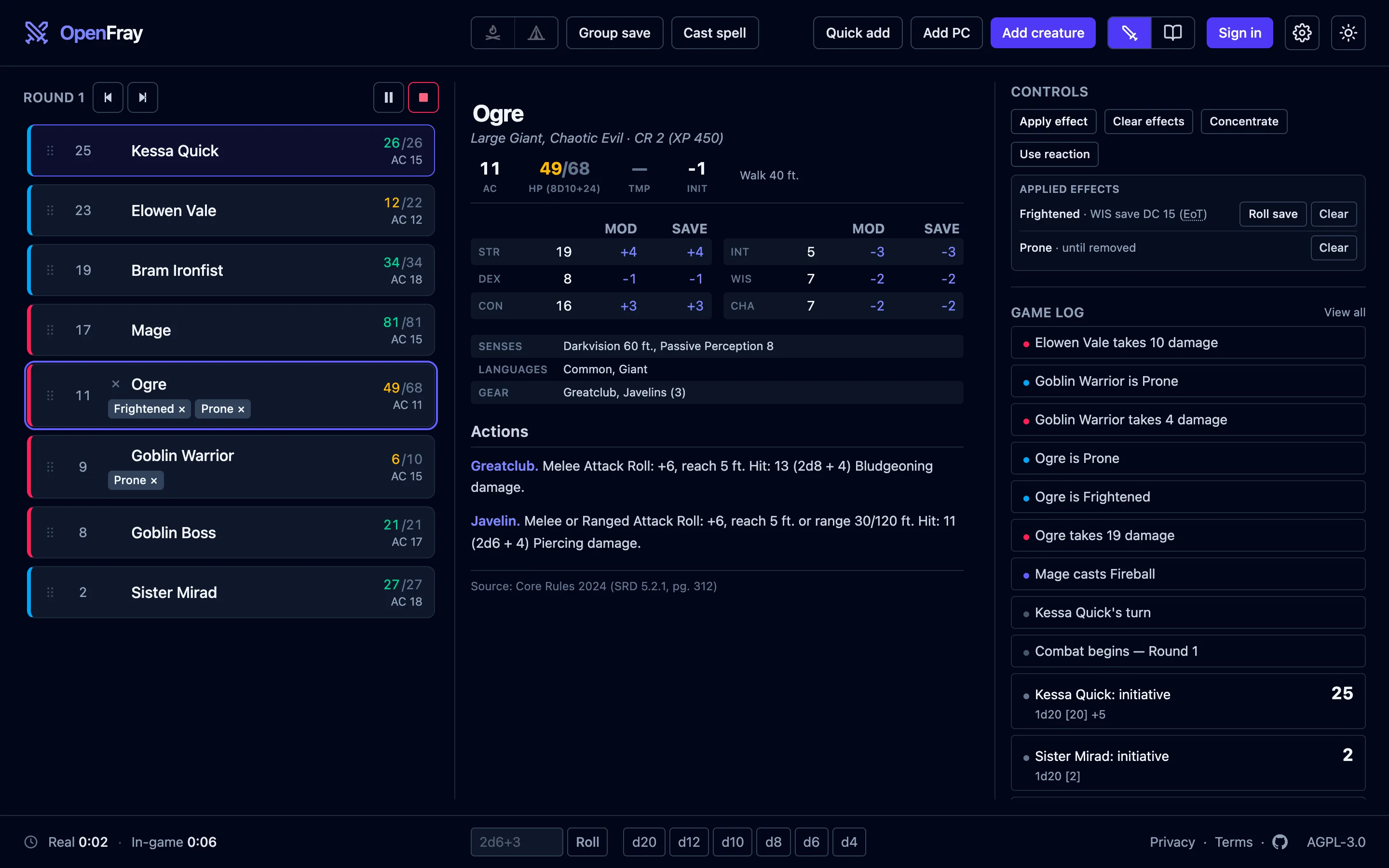
Click Begin and OpenFray asks for everyone’s initiative. It rolls the creatures and leaves the players blank for you to type what they rolled. As turns advance, timed effects count down and clear, creatures regain reactions, and recharge abilities roll to see whether they return. Effects can prompt a saving throw at the start or end of a creature’s turn, whichever you chose.
Add a creature mid-fight or move a row: the turn stays with the creature taking it. Fallen creatures stay in the order, grayed out and skipped, in case they come back.
Remember what changes the next roll
Reckless Attack goes on the barbarian and grants advantage to whoever swings at them. Vicious Mockery goes on the goblin and changes the goblin’s next attack. OpenFray works both into the roll when it happens.
The same effect controls cover conditions, advantage, disadvantage, bonuses, penalties, reminders, and effects that end with a saving throw. An effect can change a creature’s own rolls or the rolls made against it.
For anything else, write a reminder. It stays on the row until you clear it and makes no changes to rolls or stats.
What creatures have left to spend
A creature’s resources run down as you use them, and come back when they should: legendary actions and their per-round budget, legendary resistance with its separate in-lair count, recharge abilities, limited-use actions, spell uses counted per spell, and the one reaction each creature gets per round.
Click a spell in the stat block and OpenFray fills in the creature’s save DC and attack bonus, spends the use, and opens the attack or group-save controls. A concentration spell starts the caster concentrating, with a timer.
Resolve the Fireball together
Attacks resolve from the stat block: pick a target, roll to hit against its armor class, then apply damage that already accounts for what the target resists, is immune to, or is vulnerable to. Critical hits follow your table’s rule.
Group save handles every target of a Fireball together. Each creature makes its own saving throw, with its bonus, Magic Resistance, and Evasion accounted for. Apply the damage in one step, full or half per creature. A creature with legendary resistance can turn a failed save into a success in the same box.
The log shows the dice behind each result. Rolls use the browser’s cryptographic random generator, with no smoothing of streaks.
Players roll their own dice; enter their results when the console asks.
Your creatures, your table
The built-in compendium carries the SRD’s creatures and spells, searchable, with full stat blocks and spell cards. Beyond it:
- Build your own. A full stat-block editor for creatures and a card editor for spells. You give the ability scores and the challenge rating; OpenFray derives the attack bonuses, save and skill bonuses, and the spell save DC from them.
- Save your players. Build a character once, with armor class, hit points, abilities, defenses, senses, and private notes, then drop them into any fight instead of typing them again.
- Campaigns. Your table’s rulings, set once: critical hit damage, how surprise works, how creature hit points are rolled, and how initiative ties break. Every fight you run under that campaign uses them.
What the alpha leaves for later
The alpha has no shared read-only player view. A second screen showing turn order and conditions to the table is planned for a later release.
If a rule behaves incorrectly or a creature renders badly, report it in the issue tracker.
Bring your table back next time
You can run a fight without an account. A free account keeps your creatures, spells, characters, and campaigns available between devices, so you can reuse your party and your table’s house rules.
Open the console to run your first fight. Sign in with Google or Discord to save your characters, creatures, and campaigns.