Free · Open source · No account
Never lose concentration.
OpenFray holds the whole state of a Dungeons and Dragons encounter — who’s frightened by whom, who has advantage on whom, what every creature has left to spend — so you run it instead of remembering it.
- Nothing to install
- No account needed
- Compatible with 5.5e and 5e
A fight in progress
The whole encounter on one screen
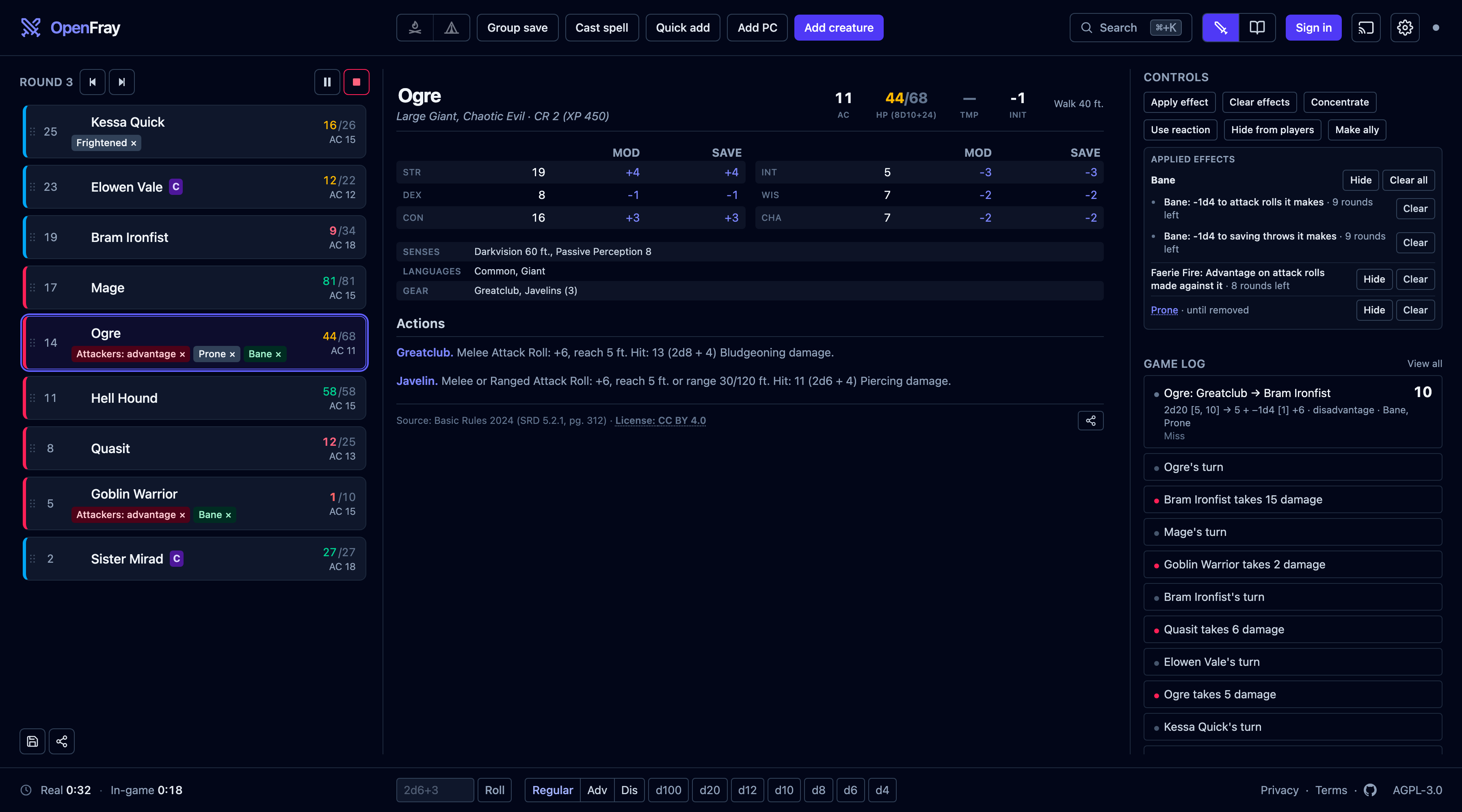
- 1The trackerTurn order, hit points, and every condition as a chip on its row.
- 2The stat blockThe active creature, its actions one click from rolled.
- 3The game logEvery change written down, with the dice behind it.
The difference
What OpenFray keeps hold of
Effects have two ends, and OpenFray records which end is which. The cleric's Bane rides the Ogre's own rolls; the wizard's Faerie Fire arms everyone who swings at it — and when the Ogre finally attacks, all of it is already in the arithmetic.
A scratchpad, not a second character sheet: it never asks for a player's build. It tracks what just happened and what has to be remembered this round — which is why it stays fast instead of becoming a worse VTT.
The crunchy moments
Six creatures, one Fireball, one click
One spell hits six creatures, and OpenFray rolls every save at once with each one's defenses applied — the Goblin Warrior fails on a 2 and owes all 32, the fire-immune Hell Hound reads 0, the Quasit saves and still resists, down to 8. Cast straight from the stat block, and the whole spell card comes with it.
For your players
Share the fight, keep your secrets
A live view on their own devices
Share a link and the turn order, conditions, and game log follow the fight on your players' screens as you run it. It's read-only — there is nothing there to press.
You choose what they see
Hit points in words — Bloodied, not a number — or exact, or hidden. Armor class held back, rolls without the dice, any creature kept off their screens until you reveal it.
Nothing stored, nothing to set up
It works without an account. The board goes straight to their screens and is kept nowhere — stop sharing and it's gone.
Your books, your monsters
Bring the libraries you actually use
Over 2000 creatures included
- Basic Rules 2024 (SRD 5.2.1)
- Basic Rules 2014 (SRD 5.1)
- Tome of Beasts 1 (Kobold Press)
- Tome of Beasts 2 (Kobold Press)
- Tome of Beasts 3 (Kobold Press)
- Creature Codex (Kobold Press)
And OpenFray's own, free to read and use:
Plus a full homebrew editor, and a free importer that turns a D&D Beyond creature page into an OpenFray creature — Chrome or Firefox.
Start here
Your first fight, in three steps
- 1Add your partyThe Add PC popover takes a name, an armor class, and hit points. Quick add covers whatever wanders in.
- 2Pick the foesSearch over 2000 creatures across the libraries your table enabled, or bring your own homebrew.
- 3BeginType your players' initiative rolls, the monsters roll their own, and Start combat orders the board.
The rest of the table
Everything else you'd expect
Honest dice, written down
Every number equally likely, and every roll logged with the dice behind it.
End-of-combat recap
Experience earned, how long the fight ran, and the hits your table will retell.
Campaigns with house rules
Your table's rulings set once and applied to every fight. Needs a free account.
A durable roster
Save your players once and drop them into any fight — with a free account — plus a quick add for whatever wanders in.
Nothing waits on the network
The fight lives in the browser and saves in the background. Rolling a die answers instantly.
Sync when you want it
Sign in free with Discord or Google to pick a fight up on another device.
Plays beside your other tools
A paper map on the table, players rolling on D&D Beyond, the fight on OpenFray. It never asks to take over: it does not do maps and will not, so the battlefield stays wherever you already run it.
When you're ready
Everything works without an account
The free account is for keeping. Sign in with Discord or Google and your fights, custom creatures, characters, and campaigns follow you between devices. Everything on this page works before you do.
It is also what lets you save a fight as it stands and pick it up next session, and publish an encounter to a link another Game Master can open and run. You decide what a published page says and you can take it down again, at any time. How publishing works →
Open source
Free to use, and built in the open
Version 1.2
Out of beta, and running tables. The console is free and ad-free, with no paid tier — this is the whole product, signed in or not.
Open all the way down
The code is AGPL-3.0 and every line of it is public. The creatures and rules in our own books are Creative Commons.
Tell us anything
A bug, a rule OpenFray gets wrong, or something your table needs and can't find — open an issue and it gets read.